

Advertisement · Hekalu Company
Learn more →Elim Gardens, Konza City - From Sh 550,000/=
Firm Foundations, Trusted Solutions. From prime land sales to borehole drilling and quality construction.

Real stories from across Kenya and Africa. Grounded, independent, video-first journalism from LNN.
This article examines the business potential of leasing land for hospitality investment, using an entrepreneur’s experience in Amboseli as a starting point. Her account is presented as a personal experience, not a guarantee of commercial success or a universal guide to land acquisition.
Buying prime land in a tourism destination can cost millions. Building a lodge on it costs considerably more. But what if you could enter the hospitality business without purchasing the land?
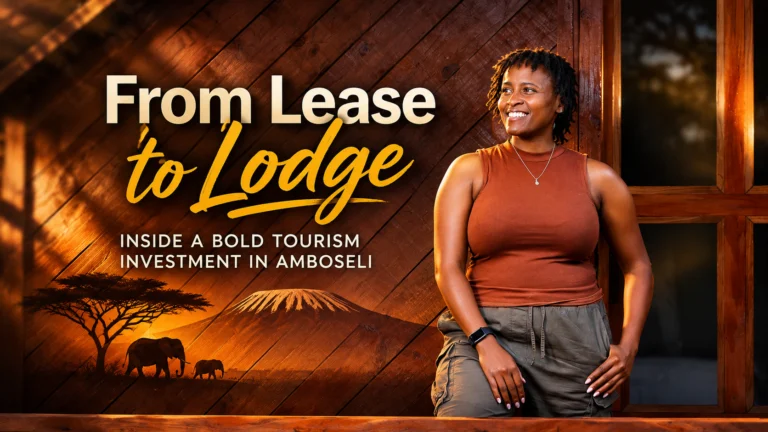
Mwihaki, a Kenyan entrepreneur and project manager by profession, took an unconventional route into the tourism business in Amboseli. Rather than purchase land, she secured a lease on three acres of rocky terrain whose owner was willing to lease rather than sell. It was a decision that would lay the foundation for Olemayian Amboseli Cottages.
With an introduction from her grandfather, she negotiated with the landowner, sought legal assistance and secured an agreement to develop her tourism venture.
It was an unconventional entry into an industry where established players have spent years building properties, brands and international distribution networks.
But her journey also exposed the less glamorous side of hospitality investment. Construction had to be suspended after officials raised concerns about missing approvals.
Her experience raises a bigger question: Can leasing land give ordinary Kenyan entrepreneurs a realistic opportunity to enter the country’s tourism industry, or are the financial and regulatory barriers simply too high?
Kenya’s tourism industry is growing, and the latest figures present an encouraging picture.
According to the Kenya National Bureau of Statistics (KNBS) Economic Survey 2026, international visitor arrivals increased by 6.2 per cent to approximately 2.55 million in 2025. Hotel bed-nights increased by 12.6 per cent to 11.56 million.
Amboseli National Park recorded 295,900 visitors, compared with 266,100 in 2024.
These numbers suggest an attractive market for hospitality investors. However, there is another statistic worth paying attention to.
Despite the growth in tourism, occupied bed-nights in game lodges within national parks and game reserves declined from approximately 1.12 million in 2024 to 1.04 million in 2025.
The distinction matters. More people visiting a destination does not automatically mean more guests booking accommodation at every lodge.
For a new investor, this means understanding the target market, pricing, occupancy patterns and competition before committing capital.
The appeal of leasing is straightforward. Instead of spending substantial capital purchasing land, an entrepreneur can direct more money towards developing the actual hospitality business.
This creates opportunities for landowners who have suitable property but lack the resources to establish tourism facilities themselves.
However, leasing does not eliminate the biggest expenses associated with hospitality development.
Construction, water supply, electricity, waste management, accommodation facilities, staffing, maintenance and marketing still require considerable investment.
There is also the question of how quickly the business can recover its development costs.
Imagine investing millions of shillings in buildings and infrastructure on land you do not own. What happens when the lease expires? Can it be renewed? Who owns the permanent structures? What compensation is available if the agreement is terminated prematurely?
These are not minor contractual details. They can determine whether an otherwise attractive investment makes financial sense.
A properly negotiated and registered lease, supported by independent legal due diligence, is therefore essential.
Investing in Amboseli comes with considerations that may not apply in the same way to an ordinary hospitality development.
Land ownership and wildlife conservation are closely connected in the ecosystem, where community landowners, conservation organisations and tourism operators have competing but interconnected interests.
For investors, this creates an additional layer of due diligence.
It is important to establish who legally owns the property, who has authority to lease it, whether the proposed development is permitted and whether community or conservation arrangements impose restrictions on its use.
The entrepreneur’s experience also illustrates how easily construction can run into regulatory complications.
A registered lease does not automatically authorise someone to construct and operate a hospitality facility.
Investors must consider county development and building approvals, applicable environmental assessments through NEMA and the relevant Tourism Regulatory Authority licensing requirements.
There is also a current regulatory debate worth watching.
Kenya’s tourism licensing framework is also facing scrutiny over the division of responsibilities between national and county governments.
On November 5, 2026, the Council of Governors called on the Senate to withdraw the Tourism (Tourism Enterprises) Regulations, 2026, arguing that they give the Tourism Regulatory Authority (TRA) licensing powers that could undermine county governments’ constitutional mandate to regulate trade and local tourism.
The dispute centres on whether tourism operators should face overlapping licensing requirements from national and county authorities, potentially increasing compliance costs and creating uncertainty for businesses.
The Senate Committee on Delegated Legislation subsequently sought further submissions from tourism officials before making its recommendations, with the review period extended to December 3, 2026.
For entrepreneurs entering the hospitality industry, the outcome matters. Clear licensing responsibilities are essential for understanding compliance costs, avoiding duplicated requirements and planning investments with confidence.
Even after securing land and obtaining approvals, a new hospitality business must compete with established safari lodges and international hotel brands.
These businesses often have stronger brand recognition, established relationships with tour operators and access to international booking networks.
Smaller operators must find another way to attract customers.
Personalised service, distinctive accommodation, cultural experiences and specialised safari packages can help create a competitive identity. But effective marketing, online visibility and consistent service delivery remain essential.
Investors must also account for seasonal demand and ensure that the business can sustain itself during quieter periods.
The Amboseli entrepreneur’s decision demonstrates that owning land does not necessarily have to be the starting point for entering Kenya’s hospitality industry.
Leasing can create opportunities for entrepreneurs and landowners alike, potentially lowering the initial financial barrier and encouraging new investment.
But the real test is not whether someone can secure three acres and build a lodge. It is whether the business can recover its investment, meet its obligations and remain profitable within the lease period.
Kenya’s tourism industry needs more innovative local investors. Perhaps the next generation of hospitality businesses will not begin with someone buying prime land, but with someone identifying an opportunity on land they can lease.
The opportunity is there. The business model, however, must make sense.



Leave A Comment