

Advertisement · Hekalu Company
Learn more →Elim Gardens, Konza City - From Sh 550,000/=
Firm Foundations, Trusted Solutions. From prime land sales to borehole drilling and quality construction.

Real stories from across Kenya and Africa. Grounded, independent, video-first journalism from LNN.
This article examines President William Ruto’s recent remarks on the right to protest against the documented history of police brutality and alleged human rights violations in Kenya. It distinguishes the President’s statements, official government figures and findings by independent human rights institutions from questions about political motives, which remain matters of public scrutiny rather than established fact.
President William Ruto has made an interesting declaration.
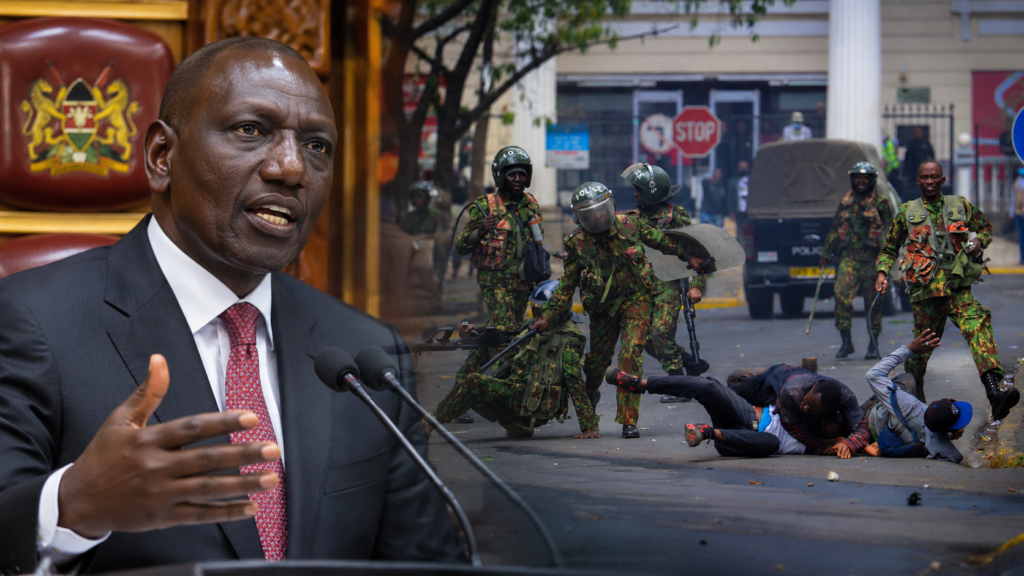
Speaking during his State of the Nation Address in Parliament on November 18, 2026, the President reaffirmed that Kenyans have a constitutional right to assemble, demonstrate, picket and present petitions to public authorities.
He went further, acknowledging that state security officers had committed wrongdoing during protests and insisting that officers who used unlawful force or exceeded their authority must be held accountable.
He even reminded the country that Kenyans must remain free to criticise their government and express disagreement.
These are important statements. In fact, they are statements every Kenyan should welcome.
But there is one rather uncomfortable question: Where has this understanding been all along?
Article 37 of the Constitution of Kenya has not just been introduced. It has been there since 2010. The right to peaceful assembly is not a presidential favour, nor is it a privilege that citizens must earn by agreeing with the government.
It is a constitutional right.
And for several years, Kenyans who attempted to exercise that right have experienced something very different from what the President described in Parliament.
On June 25, 2024, thousands of predominantly young Kenyans took to the streets to oppose the Finance Bill 2024.
What began as a nationwide expression of dissatisfaction with proposed taxation became one of the most consequential episodes in Kenya’s recent political history.
The protests were met with an extraordinary security response. Protesters were shot, people died, others sustained serious injuries, and reports of abductions and enforced disappearances emerged.
Human Rights Watch reported that the Kenya National Commission on Human Rights had documented at least 63 deaths and 87 abductions between June and October 2024. At least 26 people abducted during that period were still missing, according to the commission’s findings cited by the organisation.
The concerns did not end in 2024.
In 2025, the country was confronted by the death of teacher and blogger Albert Ojwang while in police custody. His death triggered nationwide demonstrations and renewed questions about police accountability.
Then came the shooting of street vendor Boniface Kariuki Mwangi during the June 2025 protests. Footage appeared to show a police officer shooting him at close range. Kariuki later died.
These were not isolated conversations on social media. They were events that raised serious questions about the use of state power and the protection of citizens.
Human Rights Watch’s World Report 2026 documented continued killings, abductions, arbitrary arrests and a lack of accountability for security force abuses during 2025.
Perhaps the most uncomfortable evidence against the idea that Kenya has turned a corner is what happened during the second anniversary commemorations of the 2024 protests.
On June 29, 2026, the Kenya National Commission on Human Rights issued a statement documenting alleged enforced disappearances, torture, unlawful use of force and arbitrary arrests connected to the June 25 demonstrations.
The commission documented seven incidents of enforced disappearance.
Among those reported were six protesters who were arrested outside Parliament, placed in a police truck and taken away. According to the commission, police initially denied holding them. The six were subsequently abandoned along Langata and Ngong roads in the early hours of June 27, reportedly traumatised and having suffered torture.
Another protester, Davis Lichuma, was found four days after his arrest and was hospitalised.
These are findings and allegations documented by Kenya’s constitutional human rights watchdog. They demand serious investigation.
So when the President now tells Parliament that Kenyans should be allowed to demonstrate peacefully, the question is not whether the Constitution permits it.
The question is whether the institutions responsible for protecting that right have changed how they operate.
A year after the 2024 protests, we took our cameras to Nairobi during the June 25, 2025 commemoration.
What we encountered was a gathering of Kenyans who had returned to remember those who had lost their lives, demand justice and question what had become of the promises made after the demonstrations.
One interviewee spoke about compensation for families who had lost loved ones and people whose property had been destroyed. They questioned the government’s priorities, particularly when citizens continued to struggle to access basic services such as medicine.
Another young Kenyan explained that they had returned because they believed they had a responsibility towards the country’s future.
Others spoke about solidarity with those who had been shot, the need for justice and their frustration with the country’s leadership.
One of the speakers made a particularly important distinction: seeking justice was not the same as seeking disorder.
That distinction matters.
People do not lose their constitutional rights simply because their demands make those in power uncomfortable.
The voices we captured that day were not simply about remembering the dead. They were about demanding answers from a government that had made promises but had yet to convince many Kenyans that meaningful accountability was taking place.
And now, more than a year later, the President is standing before Parliament reaffirming those very rights.
It is worth asking what has happened between those two moments.
During his address, President Ruto said the government had allocated KSh 2 billion towards compensating victims of protest-related violations dating back to 2017.
He reported that KSh 1.2 billion had been paid to 1,476 verified beneficiaries by July 2026. These included civilian victims and police officers injured while on duty.
Compensation is important. Families who lost breadwinners and individuals whose lives were permanently altered deserve support.
But there is a fundamental difference between compensating victims and holding perpetrators accountable.
Who authorised unlawful operations? Who gave orders? Which officers used excessive force? Who was responsible for the abductions? What happened to those who disappeared? How many officers have actually faced prosecution and conviction?
These are not questions that can be answered by announcing a compensation budget.
Indeed, the President himself acknowledged that compensation does not replace accountability and said investigations must continue, with prosecutions following where evidence warrants.
That commitment must now be measured against actual investigations, prosecutions and judicial outcomes.
A government cannot simply pay for the consequences of violations while leaving the circumstances and responsibility for those violations unresolved.
There is another dimension to the President’s latest remarks that deserves public scrutiny.
Kenya is approaching the 2027 General Election. The political environment is changing, public dissatisfaction remains a subject of national debate, and the generation that took to the streets in 2024 has demonstrated that it is prepared to question those in power.
Against that backdrop, the President’s decision to publicly acknowledge wrongdoing by state security officers and reaffirm the right to protest raises an obvious political question.
Is this a genuine institutional shift, a recognition of past failures, or an attempt to change the political conversation ahead of an election year?
We cannot establish the President’s private motivations from a parliamentary speech. But Kenyans are entitled to examine the timing and judge the administration by what follows.
Political leaders often make their most reassuring declarations when public confidence is under pressure. The real test is whether those declarations translate into policies, institutional reforms and consequences for wrongdoing.
The President does not need to convince Kenyans that they have a right to protest. The Constitution already settled that question.
He needs to demonstrate that exercising that right will not expose citizens to unlawful violence, intimidation, abduction or death.
There is a danger in our politics of treating every presidential declaration as a new beginning.
A leader acknowledges wrongdoing, promises investigations, announces an allocation and makes a reassuring statement. The country applauds, the news cycle moves on, and the difficult questions gradually disappear.
Until the next incident.
We should not dismiss the President’s remarks. Acknowledging state wrongdoing is important, particularly when public institutions have previously been accused of denying or downplaying abuses.
But neither should Kenyans confuse an admission with accountability.
Perhaps the better question is not whether Kenyans are too quick to believe political promises. It is whether we have developed the political discipline to demand evidence before declaring that things have changed.
We should be asking for publicly accessible investigation reports, prosecutions, convictions where guilt is established, transparent compensation records and meaningful reforms in how the police manage demonstrations.
And perhaps the most important question is whether the government will respect the rights of people who continue to disagree with it.
I find it particularly interesting that the President has now publicly defended a constitutional right that Kenyans have repeatedly had to fight to exercise.
But the real test of this declaration will not be another speech in Parliament.
It will be what happens the next time Kenyans peacefully assemble to express dissatisfaction with the government.
Will police facilitate their demonstration, as the Constitution requires, or will we once again witness excessive force, arbitrary arrests and intimidation?
Will those who violate the law be held accountable, regardless of their rank or political connections?
Kenyans should not have to risk their lives to establish whether a constitutional promise is genuine. Nor should anyone be encouraged to put themselves in harm’s way simply to test a presidential declaration.
The responsibility to demonstrate that the country has changed rests with the government and the institutions it commands.
We have already seen what happened when Kenyans took to the streets. We have heard the families of those who died. We have listened to survivors and those who say they were abducted. We have documented their demands for justice.
The country does not need another tragedy to remind us of what is at stake.
The right to protest was never the President’s to give. And the responsibility to protect it was never optional.
Kenyans are not asking for permission to exercise their constitutional rights. They are asking for a country in which exercising those rights does not come at the cost of their lives.


Leave A Comment