
One Pumpkin, More Than 700 Seeds: Why Saving Indigenous Seeds Matters for Our Food Security
At Kanya Farm, a pumpkin gifted by an experienced farmer named Martha has grown into something much bigger than a successful harvest. It has become a lesson in indigenous knowledge, organic food production, seed preservation and the importance of protecting our food heritage.
Sometimes, the most important agricultural lessons begin with something remarkably small. At Kanya Farm in Nanyuki, ours began with a single indigenous pumpkin.
The story started when Martha, an experienced indigenous farmer, gifted Lynn Ngugi a pumpkin during a visit to her farm in Gilgil. It was an ordinary gesture of generosity, but it would eventually inspire one of the farm’s most rewarding agricultural experiments.
Rather than simply eating the pumpkin, Lynn decided to preserve its seeds and see what could grow from them.
The pumpkin was opened, its seeds removed, washed and dried for almost a week. More than 200 seeds were recovered, and a portion was planted in prepared holes alongside the farm’s plantains. Manure was incorporated into the soil, with two seeds planted in each hole.
What followed was an encouraging lesson in the potential of indigenous planting material.
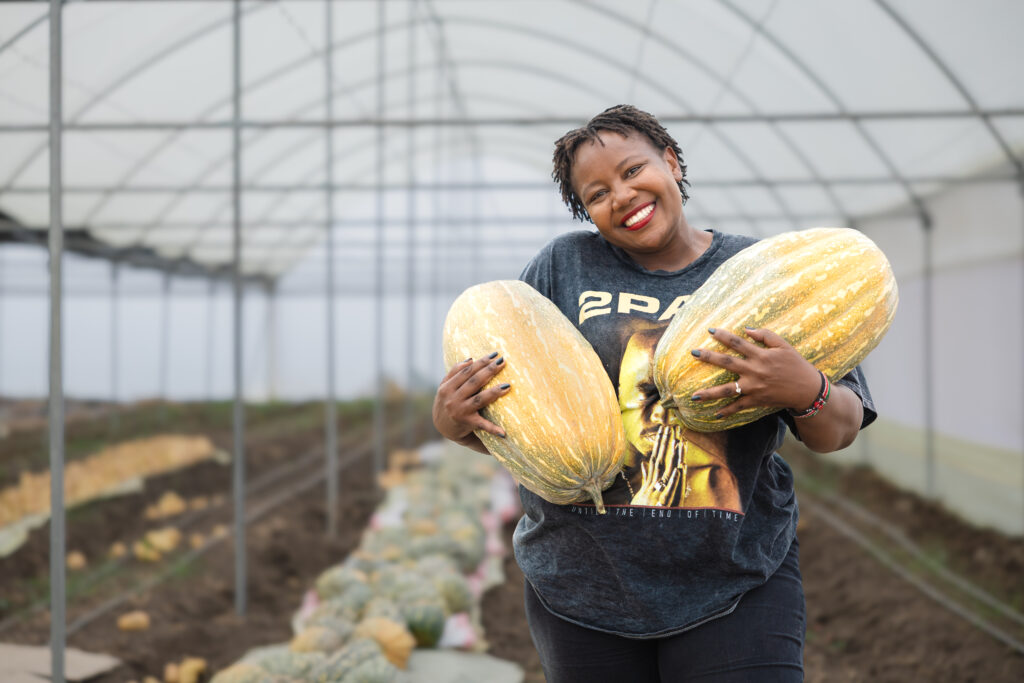
Every planted hole germinated. The vines spread across the growing area, producing several impressive pumpkins. Some weighed as much as 13 kilograms, while the average was approximately 5 kilograms, according to the farm’s harvest observations.
And here is the particularly interesting part: when one of the harvested pumpkins was opened, it contained more than 700 seeds.
One pumpkin had effectively provided the starting material for another generation of pumpkins.
The Power of Saving Our Own Seeds
Seed saving is one of the oldest agricultural practices known to humanity. Long before commercial seed companies and modern agricultural supply chains, farming communities selected, preserved and replanted seeds from previous harvests.
It was how agricultural knowledge travelled between generations.
Yet seed saving is about much more than reducing the cost of buying seeds. It is closely connected to food security, agricultural biodiversity, farmers’ independence and the preservation of indigenous crop varieties.
A 2025 scoping study on Farmer-Managed Seed Systems in Africa, published through the European Commission’s Knowledge4Policy platform, estimates that smallholder farmers, predominantly women, supply approximately 80–90% of the seeds planted across sub-Saharan Africa through traditional seed management, selection, multiplication, storage and exchange.
This is significant. It demonstrates that farmer-managed seed systems are not simply remnants of an outdated agricultural practice. They remain an important part of Africa’s food production infrastructure.
The Food and Agriculture Organization (FAO) has also highlighted how farmer-managed seed systems contribute to agricultural biodiversity, food security and farmers’ resilience. A 2024 publication by PELUM Kenya, Understanding Farmers Managed Seed Systems, similarly documents the importance of preserving and exchanging locally adapted planting material.
For smallholder farmers, saving seeds can offer several advantages:
- Reduced production costs: Farmers can retain suitable seeds from previous harvests instead of purchasing all their planting material every season.
- Greater independence: Maintaining their own seed reserves reduces dependence on external suppliers, particularly when commercial seed availability or prices become unpredictable.
- Preservation of biodiversity: Saving different indigenous varieties helps protect genetic diversity that may otherwise disappear.
- Climate resilience: Maintaining diverse local varieties creates opportunities to identify crops with characteristics suited to particular local growing conditions.
- Knowledge transfer: Seed sharing keeps traditional farming knowledge alive and allows agricultural practices to pass between generations.
This is why the pumpkin project matters beyond the harvest itself.
At Kanya Farm, we are not simply interested in growing food. We are interested in understanding where our food comes from, preserving what works and ensuring that the next planting season has a foundation to build on.
Why Indigenous Pumpkins Deserve More Attention
Indigenous pumpkins are among the crops that deserve greater recognition in African agriculture.
In many communities, pumpkins have traditionally been valued not only for their fruit but also for their leaves and seeds. Different parts of the plant can contribute to household nutrition, making it a versatile crop.
Unfortunately, indigenous food crops are sometimes overlooked in favour of commercially popular alternatives. This can mean losing access to valuable local varieties and the knowledge associated with growing and preparing them.
Research conducted in Kenya provides a useful reminder of their nutritional potential.
A study titled Nutritional Evaluation of Some Kenyan Pumpkins, published in the International Journal of Agriculture and Forestry, examined 13 pumpkin varieties collected from different parts of Kenya. Researchers identified variations in their nutritional composition, including beta-carotene, dietary fibre and minerals such as potassium and sodium.
More recent research published in the International Journal of Food Science and Technology in April 2024 also examined the nutritional properties of different parts of Cucurbita maxima. It identified carotenoids, phenolic compounds, minerals and other potentially beneficial compounds in the fruit, peel and seeds.
Some of the important nutritional benefits of pumpkins include:
1. Beta-carotene and vitamin A
The rich yellow and orange colours found in many pumpkins are associated with carotenoids, particularly beta-carotene. The body can convert beta-carotene into vitamin A, which contributes to normal vision, immune function and healthy skin.
2. Dietary fibre
Pumpkin contributes dietary fibre, which supports normal digestion and bowel health. Its fibre content, alongside its relatively low energy density, makes it a useful addition to a balanced diet.
3. Essential minerals
Studies of Kenyan pumpkin varieties have identified minerals including potassium, magnesium, calcium and iron. These minerals play different roles in maintaining normal body functions.
4. Nutritional value of the seeds
Pumpkin seeds are also worth preserving for consumption. They contain protein, healthy unsaturated fats, dietary fibre and minerals, including magnesium and zinc.
The important point is that pumpkins should not be viewed merely as seasonal vegetables or livestock feed. They have considerable potential as food crops with nutritional and economic value.
Their nutritional composition varies according to species, variety, growing conditions and preparation methods, so not every pumpkin will have identical nutritional properties.
Organic Farming Can Produce Big, Healthy Pumpkins Too!
One of the most exciting aspects of our harvest was the size of the pumpkins.
We recorded individual fruits weighing up to 13 kilograms, with an average of approximately 5 kilograms. For a farm growing organically, this was an encouraging result.
There is a persistent perception that organic farming necessarily produces smaller crops, lower yields or inferior produce compared with conventional agriculture.
Our experience challenges that assumption.
The pumpkin seeds were planted in soil prepared with manure, and the crop developed with relatively limited intervention. We did not apply additional manure during the growing period, according to our farm records.
The vines spread extensively and produced a substantial harvest.
It is important to acknowledge that one successful harvest cannot establish that organic farming will consistently produce higher yields than conventional farming. That requires properly controlled comparisons across different crops, soils, seasons and growing conditions.
However, our experience demonstrates something worth highlighting: organically grown food can be large, healthy and productive.
Organic agriculture is not about deliberately accepting poor yields or growing undersized produce. It is about managing soil fertility, protecting ecological processes and producing food through practices that minimise reliance on prohibited synthetic inputs.
At Kanya Farm, we are learning that organic farming requires observation, patience, experimentation and a willingness to adapt.
And sometimes, it produces a 13-kilogram pumpkin!
A Crop That Keeps Giving: Understanding Pumpkin Shelf Life
Another reason indigenous pumpkins deserve attention is their potential for storage.
Unlike highly perishable vegetables that need to be consumed or sold shortly after harvesting, mature pumpkins and certain winter squash varieties can remain in good condition for several months when harvested, handled and stored properly.
This makes them particularly interesting from a household food security and small-scale commercial farming perspective.
A harvest does not necessarily have to be consumed immediately. It can be stored and used gradually, helping households maintain access to food beyond the immediate harvesting season.
University of California, Davis, through its Postharvest Research and Extension Center, indicates that pumpkins and winter squash can have storage lives ranging from approximately two to six months, depending on the variety and storage conditions.
Research and extension guidance from other agricultural institutions also emphasises the importance of curing and proper storage.
For better storage results, farmers should:
- Harvest mature pumpkins carefully, using secateurs or a sharp knife.
- Leave the stem attached because removing it can increase the risk of deterioration.
- Avoid bruising, cutting or damaging the skin.
- Allow suitable varieties to cure in a warm, dry, well-ventilated environment.
- Store them in a cool, dry place with good airflow.
- Inspect stored pumpkins regularly and remove any showing signs of rot.
Oregon State University Extension recommends curing suitable pumpkins and winter squash for approximately five to seven days under warm conditions before moving them into longer-term storage.
The actual shelf life depends on the pumpkin variety, maturity at harvest, disease pressure, handling and storage environment.
Although Lynn mentioned that pumpkins can potentially last close to a year under favourable conditions, this should not be treated as a guaranteed storage period for every indigenous variety. Our own storage experience will help us establish how long this particular variety can reliably keep under Nanyuki conditions.
For farmers, this storage potential is valuable. It provides flexibility in household consumption, reduces pressure to sell everything immediately and creates opportunities to plan production and marketing more strategically.
From One Pumpkin to Our Own Seed Bank
Perhaps the most rewarding part of this entire experiment was opening one of the harvested pumpkins and discovering more than 700 seeds inside.
Think about that for a moment.
Martha gave Lynn one pumpkin. We preserved its seeds, planted them, nurtured the crop and harvested several pumpkins. We can now preserve hundreds of additional seeds for future planting.
This is the foundation of our planned seed bank at Kanya Farm.
Our intention is to retain seeds for future production and share some with other people interested in growing indigenous pumpkins.
However, seed saving also requires care. Seeds should be taken from healthy, mature fruits, properly cleaned and thoroughly dried before being stored in labelled, moisture-resistant containers in cool, dry conditions.
We also need to understand the pollination characteristics of the crop. Pumpkins can cross-pollinate with compatible varieties grown nearby, meaning saved seeds may not always produce plants identical to the original parent. Maintaining varietal purity requires appropriate isolation or controlled pollination.
A seed bank is therefore not simply a container full of seeds. It requires proper selection, documentation, storage and regular testing of seed viability.
We want to build something that is useful, sustainable and capable of supporting future generations of planting at the farm.
Food Security Begins With What We Preserve Today
The pumpkin experiment has reminded us that food security is not simply about producing enough food for today’s consumption.
It is also about preserving the capacity to produce food tomorrow.
That means protecting indigenous varieties, maintaining healthy soils, learning from experienced farmers, preserving planting material and encouraging communities to exchange knowledge.
Martha’s gift represents something that modern agriculture sometimes overlooks: the value of knowledge accumulated through generations of farming.
Her pumpkin was not accompanied by a commercial planting manual, an elaborate fertiliser programme or an expensive agricultural package. It came with a simple suggestion: preserve the seeds and plant them.
At Kanya Farm, we followed that suggestion, and the results have been encouraging.
We are still learning, experimenting and refining our farming practices. Not every experiment will succeed, and we do not expect it to. Agriculture is a continuous process of learning from both successes and failures.
But this particular experiment has given us a reason to keep going.
We began with one pumpkin. We harvested fruits weighing up to 13 kilograms. We recovered more than 700 seeds from one pumpkin and now have an opportunity to share those seeds with others.
That is the beauty of seed saving. It turns a harvest into an investment in the next harvest.
And perhaps the most important lesson is this: sometimes, protecting our food future begins with something as simple as refusing to throw away a good seed.
At Kanya Farm, we are growing more than food. We are growing knowledge, preserving heritage and investing in the generations that will come after us.
Leave A Comment