
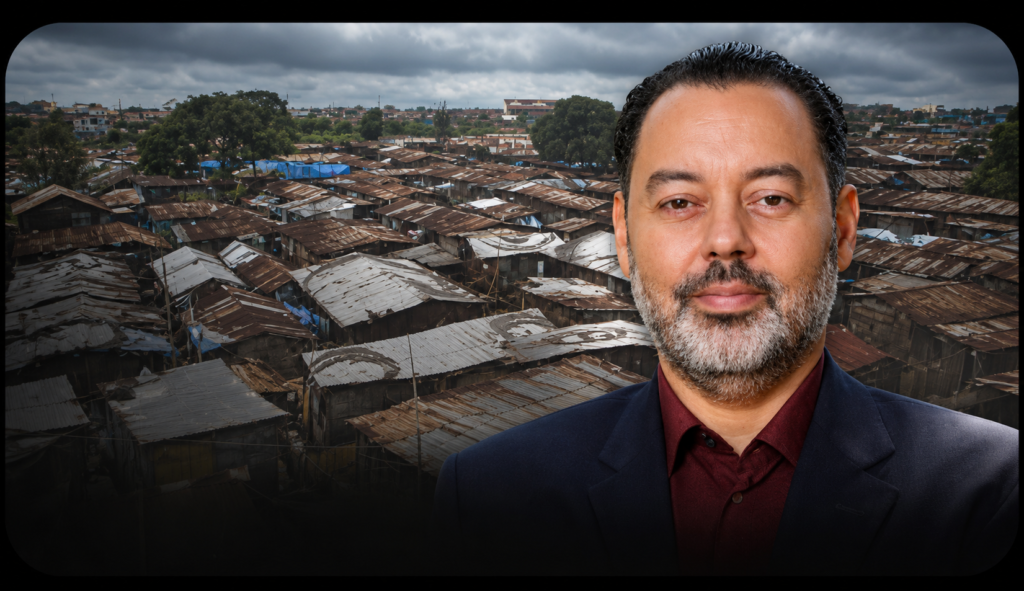
The Independence Paradox: Is Africa Politically Free But Economically Colonized?
We have our flags, presidents, national anthems and borders. But who controls what we eat, the energy that powers our economies and the technology that shapes our future? In a thought-provoking conversation on the Lynn Ngugi Show, a Tunisian economist challenges Africa to confront an uncomfortable question: Did independence deliver sovereignty, or did it merely change the face of dependence?
Independence: Freedom in Name, Dependence in Practice?
When African countries gained independence, they inherited national flags, governments, territories and the right to determine their political futures. Yet decades later, a difficult question remains: How independent can a country be when it cannot adequately feed its population, power its industries or manufacture many of the things it needs?
This was the central question in Lynn Ngugi’s conversation with a Tunisian economist, senior adviser at Power Shift Africa and associate professor of economics.
His argument was provocative: Africa achieved political independence, but economic sovereignty remains unfinished.
He distinguished three essential pillars of sovereignty: food, energy and technology. A country may elect its leaders, but if it depends heavily on external markets for essential food, imported energy systems and foreign technology, its ability to make independent economic decisions is constrained.
The guest also challenged the way Africans are taught to understand their economic circumstances. Drawing from his own educational experience in Tunisia, he questioned why colonial history and its continuing economic consequences receive so little attention in conventional economic education.
His argument was that colonial economic structures did not necessarily disappear when colonial governments left. African economies were largely positioned as suppliers of raw materials and consumers of manufactured goods. The question is whether enough has changed.
And perhaps the most uncomfortable part is that economic dependence does not always require a foreign government to issue instructions. Sometimes, the structure of the economy itself limits the choices available to its leaders.
The Food Paradox: How Can Africa Be Rich in Agricultural Potential Yet Depend on Imported Food?
One of the most striking themes in the interview was food sovereignty.
The guest argued that African agriculture has historically been shaped around export commodities such as coffee, tea, cocoa and other cash crops, sometimes at the expense of domestic food production.
There is an important distinction here. Producing food for export can generate income, employment and foreign exchange. The problem arises when agricultural priorities leave countries vulnerable to international food prices and supply disruptions.
According to UNCTAD’s SDG Pulse 2021, approximately 85% of Africa’s basic food imports came from outside the continent during 2015 to 2019. This statistic refers to the origin of food imports, not 85% of everything Africans consume. The distinction matters, but the dependence on external food markets remains significant.
Consider what happens when international wheat prices rise, shipping routes are disrupted or a major food-producing country restricts exports. African consumers can suddenly find themselves paying more for food produced thousands of kilometres away.
The guest also challenged the difference between food security and food sovereignty.
Food security asks whether people have access to sufficient food. Food sovereignty goes further by asking whether communities and countries have meaningful control over how that food is produced, distributed and accessed.
There is a dilemma here. Is importing affordable food necessarily a failure? Certainly not. International trade can improve food access and protect consumers during local shortages. But should a country become so dependent on imports that global disruptions threaten the dinner tables of its citizens?
Food security without sufficient domestic productive capacity can become a fragile arrangement.
Energy: Africa Has the Resources, But Who Controls the Technology?
The conversation then moved to energy, another area where the guest sees a contradiction.
Nigeria and Angola are major oil producers, yet the guest highlighted their historical dependence on imported refined petroleum products. This raises an important question: What is the value of extracting a resource if much of the processing, technology and industrial value addition happens elsewhere?
The same dilemma is emerging in renewable energy.
Africa has enormous solar, wind, geothermal and hydroelectric potential. Yet having natural resources is different from possessing the technology and manufacturing capacity needed to harness them.
A 2021 International Renewable Energy Agency report estimated that Africa’s theoretical renewable electricity generation potential using existing technologies was more than 1,000 times its projected electricity demand in 2040. This is an estimate of resource potential, not a promise that all that energy can be economically or sustainably developed.
Meanwhile, the electricity access challenge remains enormous. The 2026 Tracking SDG 7 report estimates that more than 560 million people in sub-Saharan Africa still lack electricity. Approximately 970 million lack access to clean cooking.
Think about that for a moment. A continent with extraordinary renewable energy resources still has hundreds of millions of people without reliable electricity.
The guest argued that the solution must go beyond installing imported solar panels and wind turbines. Africa should also invest in manufacturing the batteries, equipment, components and supporting technologies.
Otherwise, the continent risks repeating an old economic arrangement: exporting raw materials and importing finished products.
Debt: Are African Economies Borrowing Their Way Out of Structural Dependence?
The guest connected food and energy imports to a third challenge: manufacturing.
His argument was that many African economies import machinery, components, fuel and industrial inputs, undertake relatively low-value processing and then export finished products. Much of the economic value is therefore captured elsewhere.
When a country imports more than it earns from exports, it can face pressure on its foreign currency reserves and exchange rate. A weaker currency makes imported food, fuel, medicine and machinery more expensive.
Governments may then borrow to finance expenditure, support essential imports or manage economic shocks.
This creates a difficult cycle: dependence contributes to external financing needs, borrowing creates repayment obligations, and debt servicing can reduce the resources available for long-term investment.
The guest was particularly critical of the role of international financial institutions, including the International Monetary Fund and World Bank. He questioned whether their lending conditions consistently support the industrial transformation African economies need.
His criticism raises legitimate questions, although debt problems cannot all be attributed to external institutions. Domestic governance failures, corruption, poor investment decisions, economic shocks and unsustainable borrowing also matter.
One historical comparison from the interview deserves attention.
In 1953, West Germany benefited from the London Debt Agreement, which reduced its external debt from approximately 29.8 billion Deutsche Marks to 14.2 billion, alongside substantial interest reductions and extended repayment periods. Research published in the European Review of Economic History documents the agreement and its economic implications.
The question is not whether Germany and African countries have identical economic circumstances. They do not. It is whether the international community can demonstrate the same political imagination when dealing with African debt crises.
Why is debt relief possible in some circumstances but so difficult to negotiate in others?
The Green Economy: Is Climate Action Creating a New Form of Extraction?
Perhaps one of the most interesting parts of the interview was the discussion about climate change and green investment.
The guest challenged the assumption that every project labelled green automatically benefits the country hosting it.
Africa possesses minerals such as cobalt, lithium, copper and manganese, which are essential to many clean energy technologies. Yet extracting these resources without developing local processing and manufacturing capacity can leave African countries with limited economic benefits.
He questioned whether some renewable energy and green industrial projects are designed primarily around the energy and industrial needs of Europe rather than those of African communities.
He also criticised the European Union’s Carbon Border Adjustment Mechanism (CBAM), which entered its definitive phase on 1 January 2026.
The EU describes CBAM as a mechanism to ensure that imported goods face carbon costs comparable to those imposed on European production, thereby addressing carbon leakage. However, the guest raised concerns about how such policies could affect African industries that lack the financing and technology to transition quickly.
This is an important debate. Climate policy must reduce emissions, but it must also consider development inequalities.
Should Africa be expected to transition to cleaner industrial systems without access to affordable finance, technology and the industrial opportunities that wealthier countries enjoyed during their development?
Equally, should Africa accept investments that generate export revenue while leaving local communities without affordable energy, jobs or meaningful industrial capacity?
The guest’s argument was that climate action must not become colonial extraction with a green coat of paint.
Africa’s Answer: Industrialisation Through Collective Power
For all its criticism, the conversation was not simply an argument about what has gone wrong. It also explored what Africa could do differently.
The guest proposed three major priorities: food sovereignty, renewable energy sovereignty and Pan-African industrialisation.
He argued that African countries must work together to create larger markets capable of supporting industries that individual national economies may struggle to sustain.
For example, manufacturing electric buses, solar batteries, wind turbines and clean cooking equipment requires investment, technical expertise, skilled labour and a sufficiently large customer base.
A fragmented market makes that difficult. A connected continental market creates opportunities for economies of scale, investment and regional supply chains.
This is where the African Continental Free Trade Area becomes particularly relevant.
The guest also proposed strategic partnerships with China and other global powers, with technology transfer and local manufacturing made central to negotiations.
His argument was not that Africa should replace dependence on Western countries with dependence on China. Rather, African countries should use their collective resources and market power to negotiate partnerships that build domestic capabilities.
The discussion also examined the African Union’s Agenda 2063. The guest argued that Africa already has development ambitions and institutional frameworks but has struggled with implementation, funding and political commitment.
That brings us back to sovereignty. Can an institution genuinely pursue independent continental priorities if it cannot reliably finance its own programmes?
The Biggest Lie About Africa
Towards the end of the conversation, Lynn asked the guest what he considered the biggest lie told about Africa.
His answer was that Africa is poor.
He argued that the continent is extraordinarily wealthy in natural resources, agricultural potential, minerals, renewable energy and human capital. The real challenge, in his view, is who controls these resources and how much value African countries retain from them.
But there is another uncomfortable question we must confront.
If Africa is so wealthy, why do so many Africans remain poor?
Resources alone do not create prosperity. They must be managed through competent institutions, accountable leadership, investment in education, research, infrastructure and industries that create jobs and retain value locally.
Perhaps the most important lesson from this interview is that independence should not be measured only by the presence of national symbols or the ability to elect political leaders.
It should also be measured by whether people can feed themselves, access affordable energy, find meaningful employment and participate in an economy that creates value rather than simply exports it.
The guest ended with a call for Africans to become informed, educated, empowered, organised and mobilised.
And that leaves us with a question worth debating:
If Africa has the land to grow food, the sun and wind to generate energy, the minerals to build industries and a young population to drive its economy, what exactly is stopping the continent from turning its wealth into prosperity?
Perhaps the next struggle for African independence will not be fought over flags and borders. It will be fought over ownership, production, technology and the power to determine our own economic future.
Leave A Comment